{{ variable.name }} : {{ variable.values[selectedVariantsIndex[variable_index]].name }}
Quantity:
A power cable carries the last few feet of AC from the wall into a component. It can't add power a component doesn't draw, but a poorly shielded one lets noise ride in on that current.
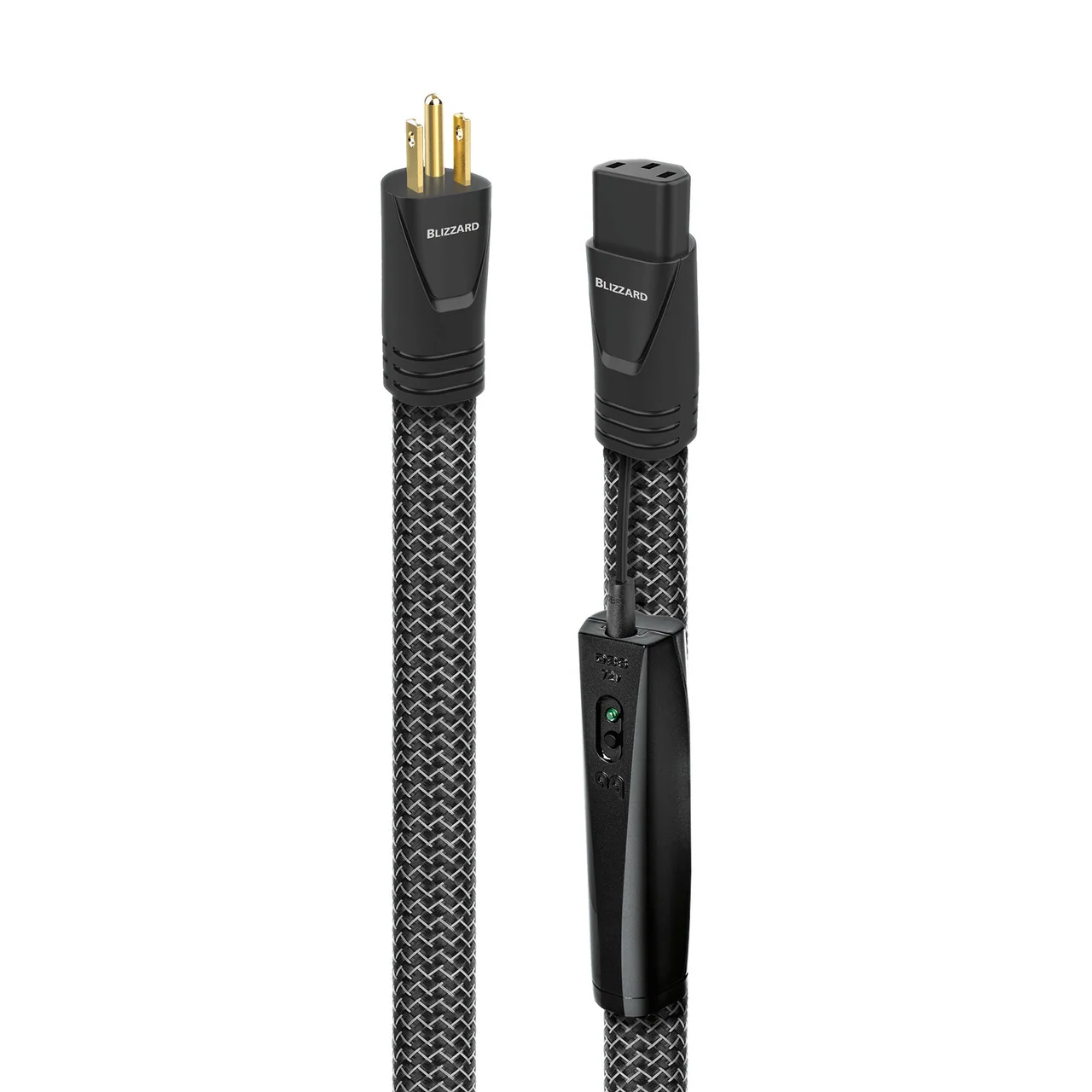
AudioQuest's Blizzard uses 100% Perfect-Surface Copper+ conductors all the way through, in a True-Concentric geometry, plus a 72-volt Dielectric-Bias System on the insulation. It is available in C13 or the higher-current C19 termination.
Where Monsoon plates Perfect-Surface Copper+ over a Long-Grain Copper core, AudioQuest says Blizzard uses only its very purest copper, 100% Perfect-Surface Copper+, through the entire conductor. True-Concentric geometry spirals each successive layer of strands in the direction opposite the layer beneath it, which places more contact pressure at points rather than along lines and further reduces strand-interaction distortion.
AudioQuest says insulation is also a dielectric that can act like a shunt filter, and biasing it minimizes dielectric noise and linearizes that filter. Blizzard's 72-volt Dielectric-Bias System (DBS) holds that bias on the insulation continuously, on top of the ZERO-Tech and RF/ND-Tech noise control carried over from Monsoon, including the patented common-mode phase-cancelling array.
Blizzard is available with either a C13 or a higher-current C19 inlet plug, so it can feed source components or the heavier draw of an amplifier, and a standard NEMA 5-15 three-prong plug for the US wall outlet at the wall end. Choose the connector that matches your component's power inlet.
Plug the C13 or C19 end, whichever matches your component, into the IEC inlet on the back of your amplifier, DAC or other component, and the male end into a wall outlet or power conditioner outlet.
Then power up the system as usual. Other and longer lengths available. Call for prices.
A power cable is one link in the chain from the wall to your gear. It usually joins these categories.
AudioQuest says insulation acts like a shunt filter, and applying a constant 72-volt bias to it minimizes dielectric noise and linearizes that filter, improving how well the cable dissipates wide-bandwidth RF noise. The battery pack carries no signal current and is sized to last for years.
AudioQuest builds its power cables to keep radio-frequency and electromagnetic noise from riding in on the AC line and reaching sensitive circuits. A ground wire without that shielding can act like an antenna, pulling in exactly the noise a power cable is supposed to keep out.
Every metal conductor oxidizes over time; it is unavoidable chemistry, not a defect. What varies is the rate. Denser, better-shielded conductors with quality plating oxidize far more slowly, so a well-made cable performs the same way for years instead of drifting.
No change to your safety ground. Every cable in this line keeps the full three-conductor path, hot, neutral and ground, exactly as building code requires. What differs from a stock cord is conductor quality and shielding, not the wiring topology.
AudioQuest Blizzard XTRM is the next rung, and the top AC power cable AudioQuest builds. It keeps Blizzard's 100% PSC+ conductors and adds the flagship Wind XTRM plugs from AudioQuest's Storm Series.
Want to learn more about power cables, AC filtration, or system setup? Visit our Learning Center for guides, tips, and expert advice.
Choose which cookies you'd like to allow. Necessary cookies keep the site working and can't be switched off.