{{ variable.name }} : {{ variable.values[selectedVariantsIndex[variable_index]].name }}
Quantity:
A power cable carries the last few feet of AC from the wall into a component. It can't add power a component doesn't draw, but a poorly shielded one lets noise ride in on that current.
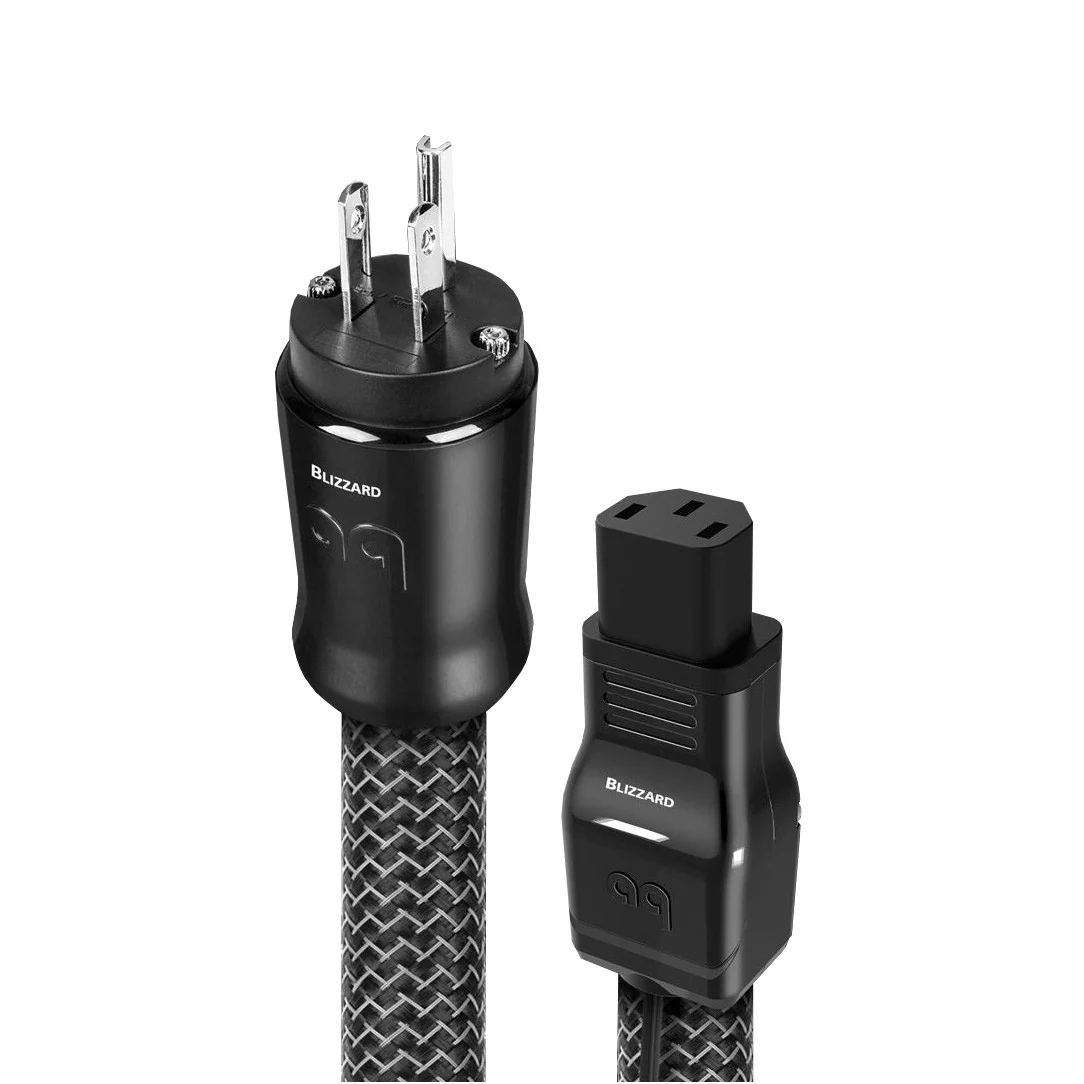
AudioQuest's Blizzard XTRM keeps Blizzard's 100% Perfect-Surface Copper+ conductors and adds Wind XTRM plugs built from the company's flagship Storm Series components. It is the top power cable AudioQuest builds that we carry, in C13 or C19.
Blizzard XTRM carries the same 100% Perfect-Surface Copper+ conductors as Blizzard, in the same True-Concentric geometry that spirals each layer of strands opposite the one beneath it. AudioQuest says the astonishingly smooth, pure metal minimizes distortion caused by grain boundaries and surface discontinuities that exist in any conductor.
AudioQuest describes the Wind XTRM plugs as cold-welded hanging-silver over red and beryllium coppers, calling them its best AC plugs, built from the components used in its flagship Storm Series. It says they enable even lower distortion and better dissipation of high-frequency noise than the high-quality molded plugs used on standard Wind Series cables.
ZERO-Tech and Direction-Controlled Conductors carry over from the rest of the range, combining low DC resistance with zero characteristic impedance for uncompressed current transfer, and draining induced RF noise away from the circuits it would otherwise disturb.
Blizzard XTRM is available with either a C13 or a higher-current C19 inlet plug, terminated in AudioQuest's Wind XTRM connector shells, and a standard NEMA 5-15 three-prong plug for the US wall outlet at the wall end. Choose the connector that matches your component's power inlet.
Plug the C13 or C19 end, whichever matches your component, into the IEC inlet on the back of your amplifier, DAC or other component, and the male end into a wall outlet or power conditioner outlet.
Then power up the system as usual. Other and longer lengths available. Call for prices.
A power cable is one link in the chain from the wall to your gear. It usually joins these categories.
They are AudioQuest's best AC plugs, drawn from the same parts bin as its flagship Storm Series. Compared with the high-quality molded plugs on standard Wind Series cables, AudioQuest says the difference shows up as lower distortion and cleaner dissipation of high-frequency noise at the connection itself.
AudioQuest builds its power cables to keep radio-frequency and electromagnetic noise from riding in on the AC line and reaching sensitive circuits. A ground wire without that shielding can act like an antenna, pulling in exactly the noise a power cable is supposed to keep out.
Every metal conductor oxidizes over time; it is unavoidable chemistry, not a defect. What varies is the rate. Denser, better-shielded conductors with quality plating oxidize far more slowly, so a well-made cable performs the same way for years instead of drifting.
No change to your safety ground. Every cable in this line keeps the full three-conductor path, hot, neutral and ground, exactly as building code requires. What differs from a stock cord is conductor quality and shielding, not the wiring topology.
Not in the AudioQuest AC power cable line we carry. Blizzard XTRM is the top of that range. If you want to go further, call us and we will talk through the whole chain.
Want to learn more about power cables, AC filtration, or system setup? Visit our Learning Center for guides, tips, and expert advice.
Choose which cookies you'd like to allow. Necessary cookies keep the site working and can't be switched off.