{{ variable.name }} : {{ variable.values[selectedVariantsIndex[variable_index]].name }}
Quantity:
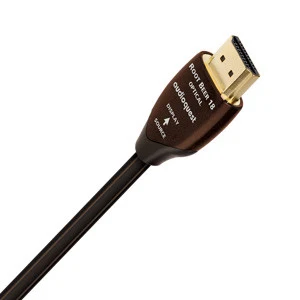
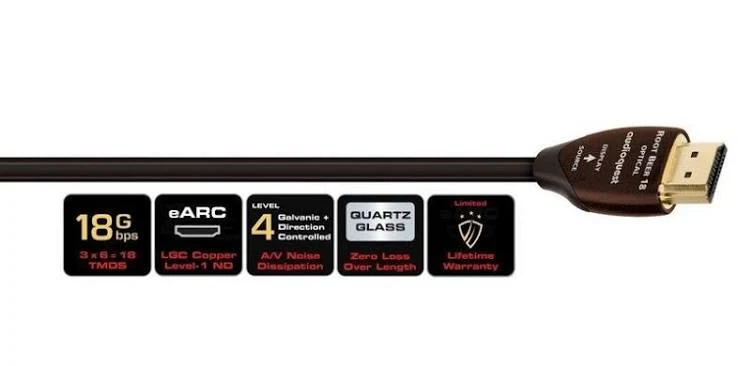
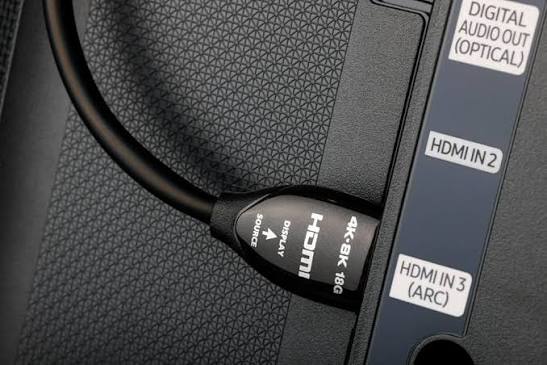
AudioQuest's Root Beer 18 is an active optical HDMI cable. Quartz glass fibers carry the picture, which AudioQuest says provides outstanding audio and video performance at distances up to 100 feet, or 30 meters. The HDMI port powers it, so no adapter is needed. It carries the full 18Gbps.
AudioQuest says optical fiber eliminates multiple forms of degradation over distance. Root Beer's quartz glass fibers carry the audio and video signal as light, and electro-optical modules in the plugs convert it at each end. Power comes from the HDMI port, so no AC adaptor is required.
AudioQuest says optical fibers provide total RF immunity and galvanic isolation for the audio and video signal, important advantages in the fight against radio-frequency noise. As with Toslink and other optical cables, the fibers do not pick up or transmit induced radio noise, no matter how long the run.
The copper that remains, the eARC and communication conductors, is controlled for direction. AudioQuest says that minimizes the radio noise that hurts active circuits, so the return channel gets the same care as the glass.
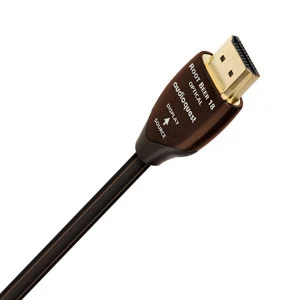
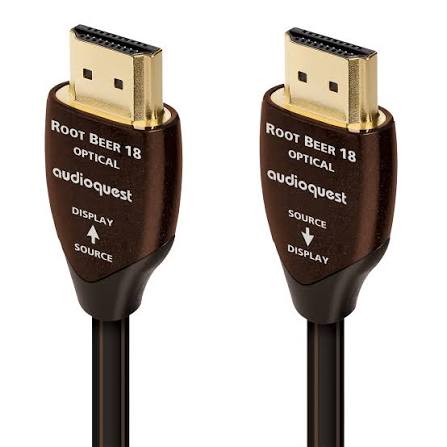
Root Beer 18 ends in a full-size HDMI plug at each end. HDMI is the flat 19-pin plug on every TV, projector, receiver and console. One cable carries picture, sound and the control signals that let the devices talk. The conversion modules live inside the plugs. Arrows on the plugs show which way to run it.
Plug one end into the HDMI output of your receiver or player and the other into the projector or TV across the room. Follow the arrows on the plugs, from the source toward the display. The HDMI port powers the cable, so there is no adapter to plug in. Then choose that input.
Then press play. Other and longer lengths available. Call for prices.
An HDMI cable is one link in a home theater chain. It usually joins these categories.
Glass carries light, not electricity, so the source and the display share no electrical path through the picture conductors. AudioQuest says optical fibers provide total RF immunity and galvanic isolation, and that, as with Toslink, they do not pick up or transmit induced radio noise.
AudioQuest says the cable is powered by the HDMI port, so no AC adaptor is required. Plug it in like any HDMI cable. The conversion modules in the plugs draw what they need from the socket.
For movies and TV, yes. AudioQuest says 18Gbps carries video up to 8K/30, HDR and eARC, and that 24 and 30 frames per second are the frame rates for almost all movies and many TV shows. Only 4K/120 and 8K/60 gaming need 48Gbps.
AudioQuest controls the direction of all 19 conductors. It says to use the cable with the arrows on the plugs pointing toward the TV, or from the source toward the AV receiver. The cable works either way, but the noise control works best as marked.
A limited lifetime warranty to the original owner, for cables bought from an authorized US dealer such as Audio Advisor. AudioQuest will repair or replace a defective cable that has not been abused. Keep your proof of purchase.
AudioQuest Cherry Cola 48 is the next rung. It moves the glass to 48Gbps for 4K/120 and 8K/60 and adds silver-plated eARC conductors and a global carbon mesh, Level-4+ Noise-Dissipation.
Want to learn more about home theater, HDMI, or 4K and 8K video? Visit our Learning Center for guides, tips, and expert advice.

Choose which cookies you'd like to allow. Necessary cookies keep the site working and can't be switched off.