{{ variable.name }} : {{ variable.values[selectedVariantsIndex[variable_index]].name }}
Quantity:
A fiber optic cable carries sound as pulses of light, not electricity, so it can't pick up the electrical or radio-frequency noise a copper cable can. What still matters is fiber quality and how cleanly the ends are polished.
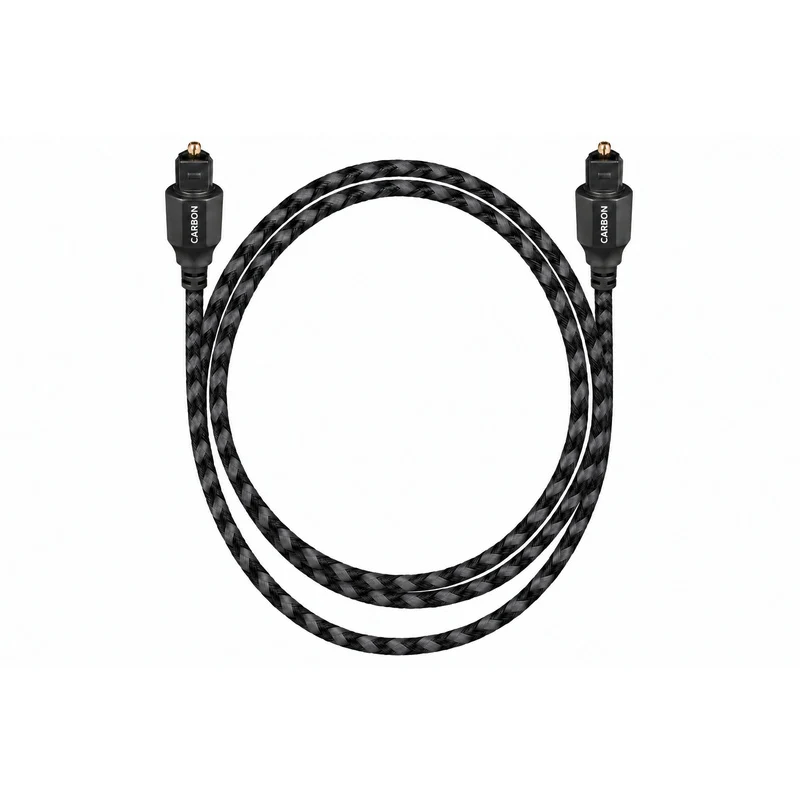
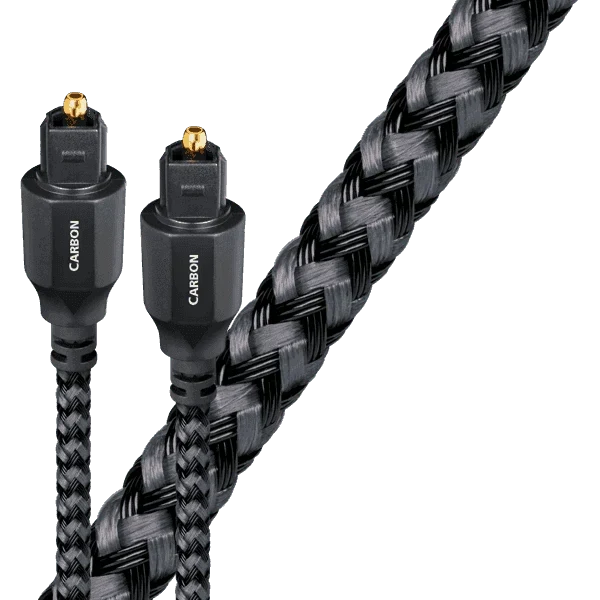
AudioQuest's Carbon takes a different construction approach than Pearl, Forest or Cinnamon: instead of one large fiber, it uses 19 narrow-aperture synthetic fibers, and it terminates in a non-metallic connector that the company says provides galvanic isolation from radio-frequency noise.
AudioQuest says most optical cables use a single large fiber, which is highly vulnerable to distortion caused by indirect light dispersion. Carbon instead features 19 narrow-aperture fibers of the highest-purity synthetic material, creating what the company calls a cleaner, more direct signal path with significantly reduced dispersion and lower distortion.
Carbon's connector uses a non-metallic connection, which AudioQuest says provides critical galvanic isolation to eliminate the transmission and pickup of induced radio-frequency noise. The company describes the result as a satisfying combination of realistic detail and natural warmth, a connector-level claim that none of Carbon's siblings elsewhere in the AudioQuest optical range make.
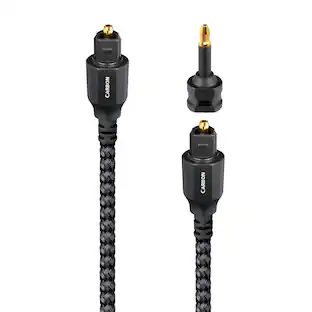
Carbon ends in a full-size Toslink plug on each end, built with a non-metallic, galvanically isolated connector body, and every Carbon cable includes a 3.5mm Mini-Adapter in the box.
Most AudioQuest Fiber Optic Digital cables come with a Mini-Adapter connector which fits over the regular Toslink optical connector. It’s used for certain types of digital audio connections and its use is strictly optional. If you don’t need it for your audio gear, just stick it in a drawer in case you need it later.
Plug the square Toslink connector into the OPTICAL OUT or DIGITAL OUT port on your source, and the matching square plug into the OPTICAL IN port on your receiver, DAC or soundbar. The connector is keyed to fit only one way.
Then power up the system as usual.
Measure the route the cable will really take from your source to your receiver, DAC or soundbar, around furniture and behind the rack. Then add a little slack. As audio legend George Cardas puts it, "A cable that's just long enough usually turns out to be just not long enough."
An optical cable often stays in a system for years, so it is easy to overlook. Look again when something else changes: a new DAC, streamer, receiver or soundbar.
An optical cable is one link between a source and a receiver, DAC or soundbar. It usually joins these categories.
AudioQuest's non-metallic connector body has no metal path linking the two ends electrically, so it can't carry ground-loop current or pick up radio-frequency noise the way a metal connector shell can. The company ties this directly to Carbon's claimed gain in detail and warmth.
AudioQuest explains it this way: dispersed light does get through a Toslink cable, but only after taking a longer path, arriving late, like a pool ball bouncing off the rails. That delayed light prevents the receiving device from decoding the signal properly. Less dispersion in the fiber means less distortion in the final analog sound.
It's plastic optical fiber, not glass. Unlike glass, it will not microscopically fracture when the cable is bent or flexed, which is what lets these cables route through tight spots without breaking.
Light travels down the fiber core with no electrical current on the cable itself, which is exactly why it can't pick up hum, ground loops or radio-frequency noise the way a copper interconnect can. The signal is decoded back to an electrical one only inside your components.
AudioQuest Vodka is the next rung, and the top of the optical range we carry. It scales the narrow-aperture fiber count from 19 up to 217.
Various portable audio devices and computers use this adapter including the iFi Gryphon, Creative Sound Blaster, KEF EGG Duo, Google Chromecast, Apple AirPort, Astell&Kern AK100II/120/240 and the Sony MZ-N505.
The answer is that shorter lengths of the cables are most commonly used in home audio systems where the cables may be visible, so they get the fancier woven cover. Longer fiber optic cables (5.0M+) are often used in home theater or commercial installations where the smooth cover makes it easier to pull the cables through ceilings and walls. What’s the difference in performance? None that we can tell.
Want to learn more about optical cables, digital audio, or system setup? Visit our Learning Center for guides, tips, and expert advice.

Choose which cookies you'd like to allow. Necessary cookies keep the site working and can't be switched off.